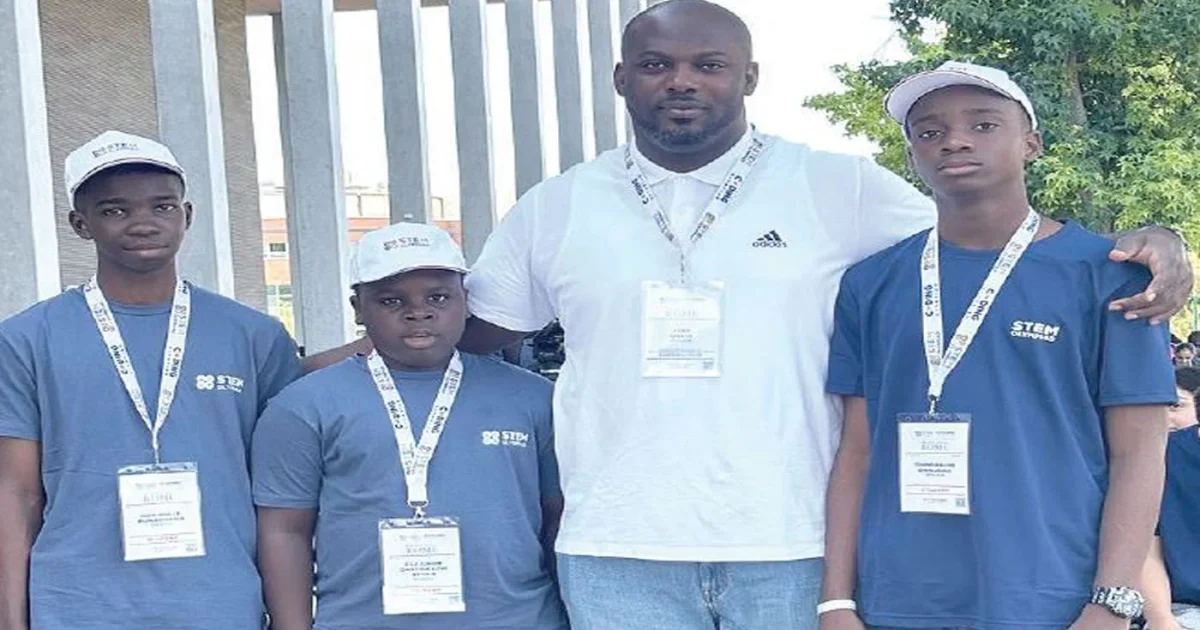
Education advocate and Chief Executive Officer of Educare, Alex Onyia, who recently sponsored a team of Nigerian students to the Grand Finale of the International STEM (Science, Technology, Engineering, and Mathematics) Olympiad in Rome, Italy, where three of them won gold medals, speaks with OLUFEMI ADEDIRAN about what inspired him to invest €30,500 in the students’ participation, and the rigorous preparations that led to their success
How many of your students won gold at the competition, and in which categories?
Three of my boys won gold medals, one in the Primary category. We also had one each in the Junior and Senior categories.
How did you feel when they emerged as gold medal winners at the STEM Olympiad?
I was very happy when they won the medals. It was one of the best feelings I have had in recent times, although there was too much tension before the results were announced. I’m super excited about the feat they achieved.
What motivated you to sponsor the students’ participation in the competition?
We needed to do something that could motivate many other children. We were inspired to participate in the competition to show that a child from any community or village can also have the opportunity to express himself in different parts of the world if he can just put in that little effort.
Child development is very important to us because I’m a catalyst; I’m trying to do something to inspire millions of other children. That is what the revolution means to me. That was my inspiration, and I’m happy that I’m seeing the outcome.
How did you identify and select the students who participated in the competition?
We hosted the South-East Mathematics Olympiad, where 11,522 children participated in the competition in March. The kids we took to the Italy event were selected from the local competition after winning the South-East Maths Olympiad. We then took them to a higher level.
When did you start preparing them for the competition?
We started preparing the students for the STEM Olympiad in March after the local competition. It was quite tough because they had already been preparing for a long time for the one we organised here, so it was a continuation of the preparations we had already begun.
How much did it cost you to sponsor them, and were there challenges in raising the funds or organising the trip for the team?
The total cost of sponsoring the kids to the International STEM Olympiad Grand Finale in Rome, Italy, was €32,500. We were able to raise €2,000 as support from people, but I spent €30,500 in cash.
I would not say I encountered challenges in raising the funds; people supported me, and I completed it. You just have to keep sharing the vision for people to support you. I shared a lot online, and that is how people bought into the vision and supported us.
What does this victory say about the quality and potential of Nigerian students?
The truth of the matter is that the brightest students in the world are Nigerians, but it is unfortunate that the country doesn’t understand it yet and is not harnessing it. Our students are our goldmine; they are the resources we have, not crude oil.
How can Nigerian students be better encouraged to participate in international competitions like this?
This is my goal, and that is why I’m so particular about their development. This is what should continually be put on the front burner. This is my project, and hopefully I will keep pushing it.
Which aspects of the students’ performance impressed you the most during the competition?
Honestly, every aspect of the students’ performance impressed me. It was a mix of emotions, and I’m grateful for the impressive outing we had.
Is the Federal Government doing enough to support gifted students in STEM?
The government is not doing anything. They are not interested in child development. Government funding of education is very poor and unfortunate. That is the truth of the matter.
Are there plans to sponsor more Nigerian students for international competitions in the future?
Yes, I plan to sponsor more students. Not only that, I plan to do more in the area of child development. It is a life’s work. I have to continue doing it. The number of students I plan to sponsor for future international events will depend on the cost and availability of funds.
It is not just about the figure; it is about what we are pursuing. It is not about the money or the cost either. I’m not trying to build things around how much I have; it is about what is important.




Following this international success, what are the next steps for these students?
We are going to push them beyond their limits. They are starting their internship soon, and during this period, we are going to develop them further. We are not giving them any breathing space.
Are they currently under any form of scholarship?
Some of them are on scholarships. One of them is on a full scholarship, while the others are also on different scholarships.
What are the biggest obstacles preventing Nigeria from producing more globally competitive STEM talents?
The government is simply not interested in things like these. If they are interested, they can do more.
What signs of anxiety or pressure did you notice in the students a few days before the competition, and how did you manage the situation until they achieved success by winning three gold medals?
Although you could see that they were panicking on the day of the examination and the anxiety level was very high, I was able to advise them on how to manage the situation.
Were there a special camp and diet for them before the competition at the local and international levels?
There was no special diet for them.
How were you able to convince their parents that what you are doing would be beneficial to them?
Most of their parents followed me on X (formerly Twitter); they see what we do, so they were convinced. In fact, they were the ones who convinced their children to participate.
When is the next competition, and have you set your mind on how you will prepare the subsequent set of students for it?
We are already in the process, but we have not decided on the date. We already have 34,461 kids registered. Ideally, we wanted to close registration at 40,000, but we may have to take a few more. We may stop at 50,000 students.
Many students deliberately avoid mathematics and some science subjects. How can a child be motivated to love these subjects?
The best thing is to correct their foundation. Any child you see who hates maths has a foundational problem. When the foundation is faulty, they struggle, and when students struggle, their patience capital is very low, and they simply give up.