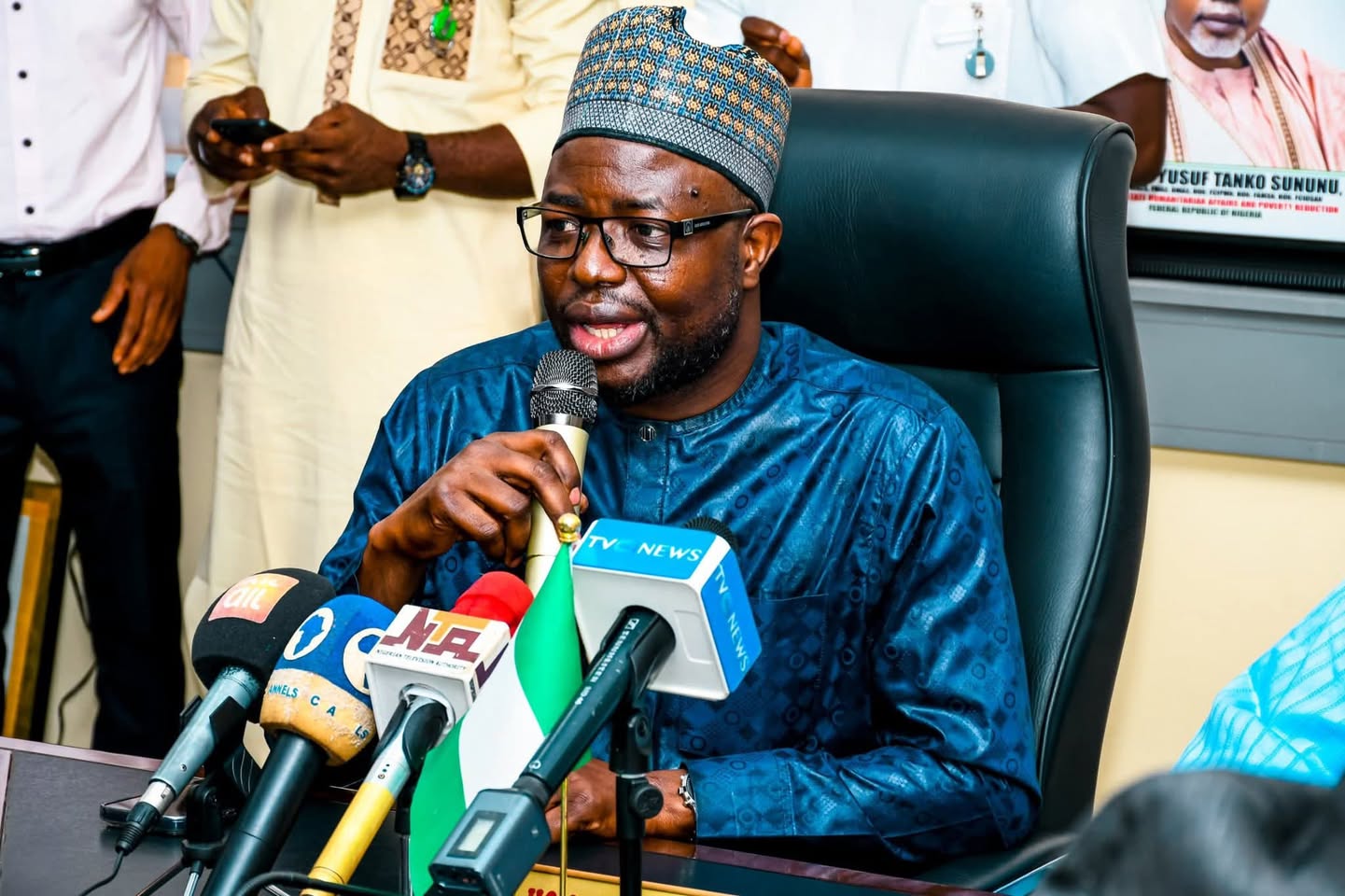
The Federal Government has unveiled a N140 billion social protection programme aimed at helping vulnerable Nigerians move beyond temporary relief and achieve sustainable livelihoods, economic empowerment and self-reliance.
The initiative, known as the Household Prosperity and Empowerment Social Protection Project (HOPE-SP), was launched at the State House Banquet Hall in Abuja alongside four other initiatives designed to strengthen Nigeria’s humanitarian response and poverty reduction efforts.
The other initiatives are the One-Humanitarian-One Poverty Response System (OHOPRS), Emergency Cash Transfer Programme, Federal Ministry of Humanitarian Affairs and Poverty Reduction Ministerial Blueprint, and Humanity First Magazine.
Government Moves Beyond Palliatives
Minister of Humanitarian Affairs and Poverty Reduction, Dr Bernard Doro, said the initiatives marked a new approach to humanitarian intervention and social protection in Nigeria.
Doro said the government was shifting from reactive palliatives towards proactive measures designed to empower vulnerable households and create pathways out of poverty.
He noted that while the economic reforms of the President Bola Ahmed Tinubu administration, including fuel subsidy removal and foreign exchange market reforms, had improved investor confidence and government revenues, vulnerable Nigerians still needed protection from economic shocks.
According to the minister, the government’s objective is to move from simply providing emergency relief to anticipating social needs and reducing poverty.
He identified fragmentation among existing social intervention programmes as one of the major challenges affecting their effectiveness.
According to him, programmes operated independently across ministries, departments, agencies and different levels of government, sometimes resulting in duplication while some vulnerable Nigerians were left without assistance.
Under the new system, vulnerable households will be identified, their specific needs assessed and appropriate interventions provided.
Doro said beneficiaries would subsequently be monitored through what he described as a “poverty graduation pathway”, designed to move households towards economic inclusion and self-reliance.
The system will also rely on unified data, digital delivery infrastructure, new financing mechanisms and real-time poverty intelligence.
Oluremi Tinubu Highlights HOPE-SP
Speaking on the initiative, First Lady Senator Oluremi Tinubu described the five programmes as important steps towards improving the lives of vulnerable Nigerians.
She said although the initiatives serve different purposes, they share the objective of improving the welfare of individuals, families and communities facing economic and social difficulties.
According to her, HOPE-SP would improve how vulnerable households are identified and supported by taking their specific needs into account.
Rather than providing temporary relief alone, she said the programme would combine immediate assistance with interventions designed to help households recover and become economically independent.
She added that the One-Humanitarian-One Poverty Response System would create a coordinated national framework for humanitarian emergencies, social protection and poverty reduction.



The Emergency Cash Transfer Programme, she explained, would provide rapid financial support to households affected by economic shocks, while the ministerial blueprint would translate the government’s humanitarian and poverty reduction priorities into measurable actions.
She also described the Humanity First Magazine as an avenue for documenting the experiences of Nigerians whose lives have been transformed through government interventions.
Bagudu Calls for Better Coordination
Minister of Budget and Economic Planning, Senator Atiku Bagudu, said effective social protection required cooperation among the federal, state and local governments as well as other stakeholders.
Bagudu said the administration’s ambition to build a $1 trillion economy by 2030 must be accompanied by deliberate measures to ensure that economic opportunities reach communities across the country.
Read Also: FG Approves Acquisition of Two Communications Satellites for Nigeria
He highlighted the government’s ward development initiative covering 8,809 wards, saying it was designed to identify factors driving poverty and exclusion at the grassroots.
The minister also said government was increasing attention to peace, security and social protection to prevent Nigerians from falling into poverty as a result of domestic and global economic shocks.
Bagudu noted that Nigeria already had substantial resources and programmes dedicated to poverty reduction, including a World Bank portfolio of about $6 billion, but stressed the need for better coordination.
He argued that the challenge was not necessarily a lack of resources but ensuring that existing programmes at federal, state and local levels were properly aligned and efficiently implemented.
Zulum Backs New Social Protection Initiative
Borno State Governor Babagana Zulum also commended the Federal Government for introducing the initiative.
Zulum said addressing poverty and social inequality was essential to tackling the underlying causes of insecurity and instability, particularly in communities facing prolonged humanitarian challenges.
He stressed that sustainable peace and security required more than emergency humanitarian assistance, arguing that government interventions must also address the conditions that make individuals and communities vulnerable.
The Federal Government said the new social protection architecture is intended to create a more coordinated and sustainable approach to poverty reduction while helping vulnerable Nigerians transition from temporary assistance to economic independence.