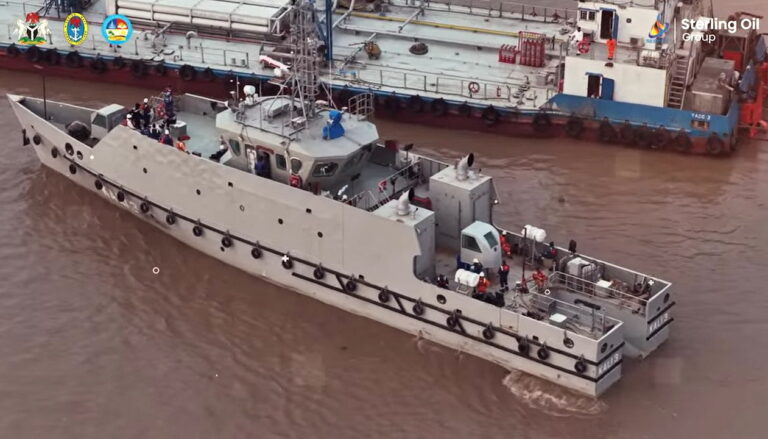
The Nigerian Navy has taken delivery of the first of 10 security support vessels (SSVs) being funded by private industry to strengthen the protection of Nigeria’s critical energy infrastructure and maritime interests.
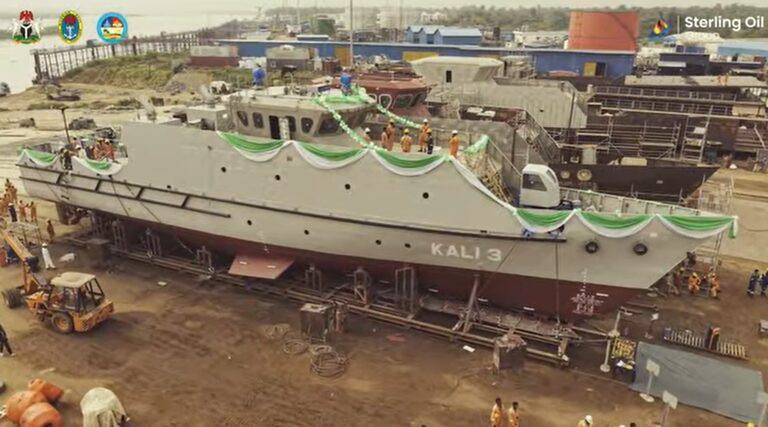
The induction ceremony for SSV Kali 3 was held on August 18 at Asemoku Jetty in Delta State and was presided over by the Chief of Naval Staff, Vice Admiral Idi Abbas.
Kali 3 is the first of 10 security support vessels being provided by Sterling Oil Exploration Energy Production Company Limited (SEEPCO) under a memorandum of agreement with the Nigerian Navy.
The second vessel, Kali 4, is reportedly nearing completion and is expected to be launched soon.
The Nigerian Navy described the initiative as a strategic public-private partnership designed to transform private-sector investment into tangible maritime security capabilities.
Vessel Built in Nigeria
The 40-metre-long Kali 3 was designed and constructed locally at the Okpai HM Shipyard in Delta State, in collaboration with the Nigerian Navy and to Bureau Veritas standards.
The Navy said the project demonstrates the growing contribution of Nigeria’s indigenous shipbuilding industry to national security and economic development.
The vessel is equipped for a range of maritime security duties, including coastal and offshore surveillance, interdiction, anti-piracy operations, maritime law enforcement and escort missions.
Two rigid-hull inflatable boats (RHIBs) are mounted on the vessel to support rapid boarding operations, while its 2.5-metre draft allows it to operate effectively in shallow waters.
Kali 3 has an endurance of approximately 10 to 12 days and is expected to support the protection of crude oil tankers, liquefied natural gas (LNG) carriers, offshore supply vessels and other oil and gas assets across Nigeria’s maritime domain.
Under the agreement with SEEPCO, the Nigerian Navy will provide personnel to man and operate the vessels.
Navy Chief Highlights Maritime Security
Speaking at the ceremony, Vice Admiral Abbas stressed the importance of protecting Nigeria’s maritime domain and critical energy infrastructure, particularly given the importance of the oil and gas sector to the national economy.
He commended SEEPCO for its commitment to the vessel programme and called on other responsible maritime stakeholders to support initiatives that strengthen national security and protect Nigeria’s economic assets.
The Chief of Naval Staff said the commissioning of Kali 3 came at an important time for the Nigerian Navy.


According to him, since the launch of Operation Delta Sentinel in January 2026, the Navy has intensified intelligence-led surveillance, patrols, interdiction operations and cooperation with other security agencies against crude oil theft and related crimes across the Niger Delta and its maritime approaches.
He said the sustained operations had restricted the activities of criminal networks, improved confidence along production corridors and contributed to a safer environment for legitimate oil and gas operations.
SEEPCO Explains Investment
SEEPCO Vice President Sandeep Singh and Raj Bhargava said the company began oil exploration activities in Delta State in 2010, when it relied on third-party barges to export crude oil.
The company said its operations are closely connected to Nigeria’s waterways and that a secure maritime environment is essential not only to the oil and gas industry but also to communities and economic activities dependent on the waterways.
SEEPCO said the SSV programme is aimed at strengthening the operational capacity of the Nigerian Navy, supporting maritime security and demonstrating how public-private partnerships can help develop a stronger and more self-reliant maritime sector.
Delta Government Welcomes Initiative
The Deputy Governor of Delta State, Monday Onyeme, described the commissioning as a demonstration of indigenous capacity, local content and successful cooperation between the private sector and the Nigerian Navy.
He said a secure operating environment was essential for investment, production and economic growth.
Onyeme reaffirmed Delta State’s commitment to working with investors, security agencies and other stakeholders to sustain the peace and security required for businesses to operate successfully.
The commissioning of Kali 3 marks the beginning of the planned 10-vessel programme and is expected to provide additional capacity for maritime surveillance and the protection of Nigeria’s strategic oil and gas infrastructure.